
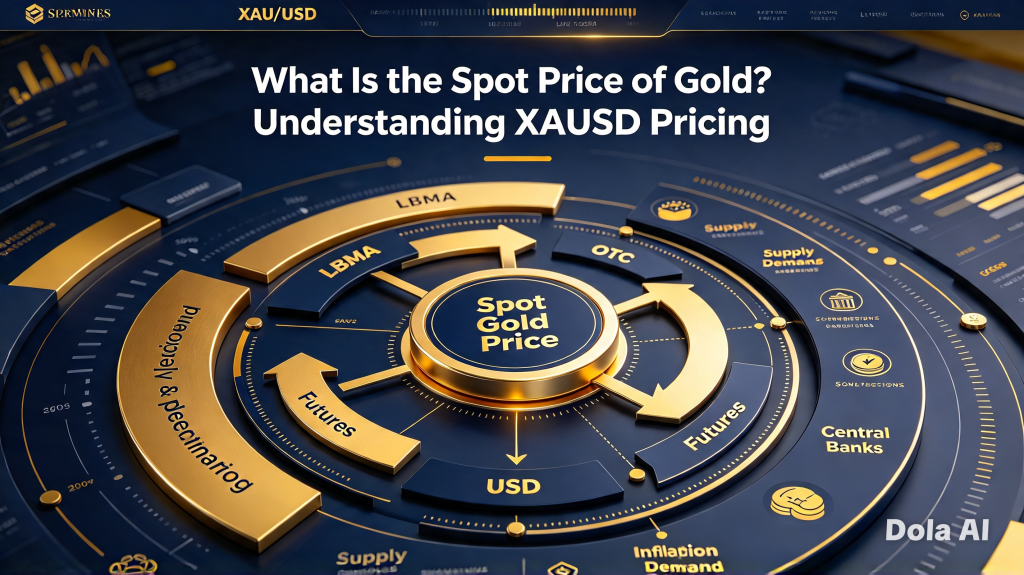
When you see gold prices flashing across financial screens or quoted in market news, you are looking at the spot price — the heartbeat of the global gold market. Yet for many traders and investors, the distinction between spot price, futures price, and retail gold cost remains unclear. This guide explains exactly what the spot price is, how it is calculated, where it comes from, and why it matters for anyone trading or investing in XAUUSD.
Replace with your AdSense code in functions.php or via filter
Defining Spot Gold Price
The spot price of gold is the current market price at which one troy ounce of pure gold can be bought or sold for immediate delivery — typically settled within one to two business days. It represents the wholesale value of gold in the global institutional market, where bullion banks, central banks, refiners, and large traders exchange metal.
Key characteristics that set it apart:
- Wholesale benchmark: It is not the price you pay at a jewellery shop or coin dealer — those include manufacturing, distribution, and dealer premiums.
- Real-time and dynamic: The spot price updates continuously during market hours as orders flow in across global trading hubs.
- Universal standard: Quoted worldwide in US dollars per troy ounce — the same reference number underpins every gold-related instrument, from physical bars to ETFs and CFDs.
- No expiration: Unlike futures contracts, spot gold has no expiry date — it reflects the value of gold right now.
The XAUUSD Connection
XAUUSD is the trading symbol that directly represents the spot gold price:
- XAU = the ISO currency code specifically for one troy ounce of gold (derived from the chemical symbol Au)
- USD = the US dollar
- Together, XAUUSD tells you exactly how many US dollars are required to purchase one troy ounce of spot gold
When you trade XAUUSD via MT5, a broker, or a chart platform, you are essentially trading changes in the global spot gold rate — with pricing derived directly from the interbank spot market.
How the Spot Price Is Actually Determined
There is no single authority that “sets” the gold price by decree. Instead, it emerges from active trading across interconnected venues:
1. The LBMA Gold Price — The Global Benchmark
The primary reference price comes from the London Bullion Market Association (LBMA) auction, administered by ICE. Held twice daily — at 10:30 and 15:00 London time — participating banks and dealers submit buy and sell orders in rounds until a price is found where supply and demand are balanced. This “fix” serves as the baseline reference for markets worldwide.
2. The 24-Hour Over-the-Counter (OTC) Market
Between the LBMA auctions, and through nights and weekends, the spot price is driven by continuous trading across London, New York, Asian, and Australian dealing desks. This is where the real-time fluctuations you see on live charts happen — as participants react to news, currency moves, and order flow.
3. The Futures Influence
COMEX gold futures in New York also play a major role. While futures prices reflect delivery at a future date, they are closely linked to spot — arbitrageurs bridge the gap, ensuring spot prices respond to shifts in futures markets and vice versa.
Spot vs Futures vs Retail — Know the Difference
Table
| Type | What It Represents | Cost Difference |
|---|---|---|
| Spot Price | Immediate settlement of wholesale gold | Base benchmark — no extra costs included |
| Futures Price | Contract for delivery on a future date | Typically higher than spot — includes financing and storage costs |
| Retail Price | Coins, bars, jewellery from a dealer | Spot price + dealer premium + manufacturing margin |
This is why a gold coin always costs more than the spot price — you are paying for fabrication, distribution, and profit margin, not just the raw metal.
Units of Measurement
Spot gold is priced in troy ounces (≈31.103 grams), not the standard avoirdupois ounce used for groceries. Common conversions:
- 1 troy ounce = 31.103 grams
- 1 kilogram = 32.15 troy ounces
- 1 gram of gold = spot price ÷ 31.103
What Moves the Spot Price
Because the spot price reflects global supply and demand in real time, these are the dominant drivers:
- US dollar strength: Inverse correlation — a weaker dollar lifts gold, and vice versa
- Interest rates & real yields: Since gold yields no interest, higher bond returns make it less attractive
- Central bank activity: Official buying directly removes supply from the market
- Geopolitical & economic uncertainty: Flight-to-safety demand drives spot higher
- Inflation expectations: Gold is viewed as a long-term store of value when purchasing power erodes
Why This Matters for Trading XAUUSD
Understanding spot pricing changes how you trade:
- Know your reference: Your broker’s XAUUSD feed should closely match the LBMA/global spot rate. Significant deviation may indicate poor execution.
- Watch the fix times: The 10:30 and 15:00 London auctions can trigger sharp volatility as benchmarks are set.
- Spot vs futures spread: During extreme market stress, spot and futures can decouple temporarily — this is normal and self-correcting.
- Settlement matters: Spot trading assumes prompt delivery — CFDs and futures bypass physical delivery entirely, which is why they are the preferred route for short-term traders.
Summary
The spot price of gold is the foundational wholesale benchmark — the universal reference point that links physical bullion, futures, ETFs, and the XAUUSD trading pair. It is not set by one person or institution; it is discovered continuously through the combined activity of London auctions, OTC dealing desks, and futures exchanges. For the trader, recognising this distinction helps separate market noise from true price movement, understand execution quality, and interpret news and charts with greater clarity.
Disclaimer: This article is for informational purposes only and does not constitute financial advice. Always conduct your own research before trading or investing. Past performance is not indicative of future results.



Leave a Reply