
xclusively for mptrading.uk · November 2026
Replace with your AdSense code in functions.php or via filter
Introduction: Why US30 Stands Alone
There is no market index quite like the US30 — the Dow Jones Industrial Average. Born in 1896, it is the oldest continuously followed benchmark in the world, yet it remains one of the most misunderstood by new traders. Unlike broader indices that weigh companies by size, the US30 follows a rare, time-tested formula: it tracks just 30 elite blue-chip leaders, where a company’s influence depends not on how big it is, but on how high its share price sits. This quirk gives the US30 a personality all its own — smoother in some moments, sharply responsive in others — and makes it a favourite of beginners and veterans alike.
This guide is built differently too. You will not find generic advice here. Instead, we will walk through exactly what makes the Dow move, when it truly comes alive, how to place your first trade step-by-step, and — most importantly — how to keep your account safe while you learn. Every rule, hour, and strategy below is written for you to apply today.
The US30 Difference: How It Actually Works
At its core, the US30 is a curated snapshot of America’s economic backbone. Its 30 components span technology, banking, aerospace, retail, pharmaceuticals, and industry — household names that shape global commerce. But here is what sets it apart:
- Price-weighted, not market-cap weighted: If Company A trades at $300 and Company B at $100, Company A moves the index three times as much, even if Company B is larger in total value. This means a small group of high-priced stocks can steer the Dow’s direction — a feature that creates distinct trading patterns you will not see on the S&P 500 or NASDAQ.
- Hand-selected, not mathematically chosen: There is no fixed formula for inclusion. Editors at The Wall Street Journal decide which companies belong based on reputation, sustained growth, and sector importance. Changes happen rarely — keeping the index stable and consistent.
- When you trade US30, you trade a contract, not shares: On your platform, US30 is almost always a CFD (Contract for Difference) — an agreement to exchange the difference in price from entry to exit. You never own stock; you simply predict direction. This means you can profit from rising and falling prices, and start with modest capital.
What Actually Moves the Dow? 4 Real-World Drivers
Forget vague phrases like “market sentiment.” These are the forces that push the US30 up or down:
1. Federal Reserve Policy — The Steering Wheel
Nothing shapes the US30 more than interest rates and bond yields. When the Fed signals lower rates or slower tightening, future corporate profits look brighter — and the Dow climbs. When rates rise, money flows out of equities into bonds — and the Dow faces pressure. Watch Fed speeches, rate decisions, and inflation reports — they set the tone for weeks.
2. Earnings from the 30 — The Engine
The US30 is compact: just 30 companies drive the whole index. When a heavyweight like Apple, Microsoft, or Goldman Sachs reports strong results, it can lift the entire Dow. When they miss, the index drops. Earnings seasons (January, April, July, October) bring sustained trends that can last for weeks.
3. Economic Data — The Pulse
Non-Farm Payrolls (first Friday of the month), CPI inflation figures, and GDP releases trigger sharp, instant reactions. These numbers tell the market how the US economy is performing — and the US30 is the first to react.
4. Global Confidence — The Wind
Geopolitical tension, major news from Europe or Asia, or shifts in the US dollar all flow through the Dow. It acts as a global confidence barometer — when the world feels steady, the US30 advances; when uncertainty rises, it may dip or consolidate.
The Golden Hours: Precisely When to Trade
The US30 does not move equally across the day. Most of the real action happens in a focused window — and trading outside it wastes money on spreads and noise:
Table
| Period | UTC Time | What to Expect |
|---|---|---|
| Pre-Market | 10:00–14:30 | Early positioning; ranges form, liquidity is thinner — good for mapping levels, not yet trading |
| New York Open — Prime Time | 14:30–15:30 | Highest energy, clearest direction — the day’s trend often takes shape here |
| Peak Liquidity | 15:30–17:30 | Tightest spreads, smoothest trends — ideal for entries and exits |
| Mid-Session | 17:30–19:30 | Deceleration; ranges often form — good for scalping established levels only |
| Close & After-Hours | 19:30 onward | Position squaring; overnight moves are thin and unpredictable — beginners should stay out |
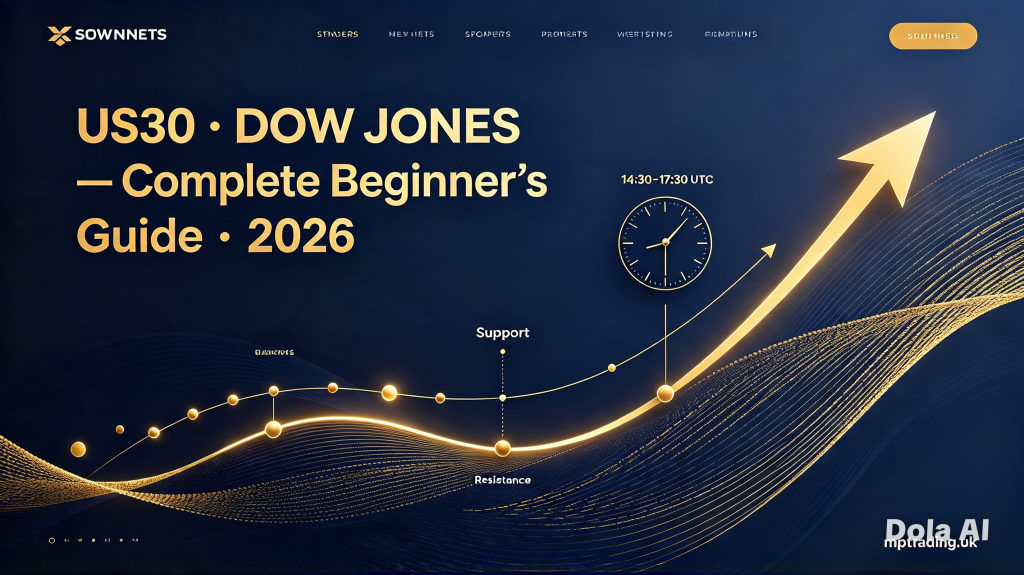
Your golden rule: Focus your screen time 14:30–17:30 UTC. This is where consistency lives. Everything else is noise until you have months of experience.
Your First US30 Trade: Step-by-Step — No Guesswork
Follow this exact workflow every time. Discipline beats intuition every single day.
Step 1 — Live on Demo First
Open a demo account and trade it seriously for at least 4–6 weeks. Same hours, same rules, same record-keeping. Only move to live money when you can show profit over four consecutive weeks. There is no shortcut around this — the market charges tuition one way or another.
Step 2 — Check the Calendar
Before looking at charts, check the economic calendar. If a high-impact release — Fed decision, NFP, CPI — is scheduled during your trading window, either:
- Sit it out, or
- Plan your entry, stop, and target before the release hits. Never decide in the heat of the moment.
Step 3 — Find the Trend
Look at the 4-hour chart and the 200-period moving average:
- Price above = favour long (buy) setups only
- Price below = favour short (sell) setups only
- Flat and choppy = stay out or trade a narrow range with tight risk
Step 4 — Map Your Levels
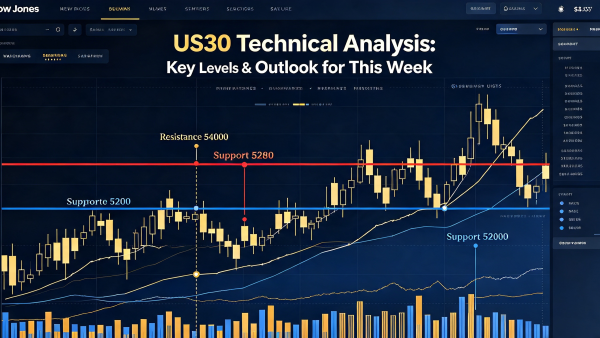
Draw horizontal lines where price has reversed or bounced repeatedly. These are your support (floor) and resistance (ceiling). Round psychological levels — 40,000, 40,250, 40,500 — act as powerful magnets. Mark them.
Step 5 — Calculate Your Risk
Decide your maximum loss before clicking anything:
- Risk no more than 1–2% of your total account per trade
- Example: $1,000 account → $10–$20 maximum loss allowed
- Divide that by your stop distance → that is your position size
- If it feels too small — good. Survival builds consistency; consistency builds wealth.
Step 6 — Enter With Confirmation
- Buy: Price falls to support → candle shows rejection (tail away from level) → enter on close
- Sell: Price rises to resistance → candle fails to break through → enter on close
- Stop-loss: Placed safely beyond the level — not too tight to get picked off, not too wide to risk too much
- Take-profit: Aim for 1.5× to 2× your risk. If risking 40 points, target 60–80 points away.
Step 7 — Let It Breathe
Once entered, do not touch your trade unless your pre-planned conditions change. Let the market hit your stop or your target. Over-managing — moving stops early, exiting too soon — is the #1 reason beginners fail.
3 Simple, Original Strategies Built for US30
Strategy 1 — The Trend Bounce
- Timeframe: 1-Hour
- Setup: Price trending cleanly above the 50-period moving average
- Entry: Price pulls back to touch the MA → candle closes away from it → enter
- Stop: Below the recent swing low
- Target: Next resistance or 2× risk
- Why it works: US30 trends longer than most indices — pullbacks to the moving average are reliable entry zones
Strategy 2 — Range Boundaries
- Timeframe: 15-Minute or 1-Hour
- Setup: Price moving sideways between two clear horizontal levels for at least 4–6 candles
- Entry: Buy near support; sell near resistance — wait for a rejection candle
- Stop: Just outside the range boundary
- Target: Opposite boundary
- Why it works: The Dow respects support and resistance exceptionally well — levels that held before will likely hold again
Strategy 3 — Opening Range Breakout
- Timeframe: 5-Minute
- Setup: Mark the high and low of the 30 minutes before the New York open (14:00–14:30 UTC)
- Entry: Buy if price breaks above that high; sell if below that low — only after 14:30 UTC
- Stop: On the opposite side of the range
- Target: Range height added to breakout level
- Why it works: The first breakout often sets the day’s direction — it is the purest signal of where institutional money is flowing
The Non-Negotiable Rules — Read These Twice
- Leverage is borrowed power — use it wisely: 1:5 to 1:10 is plenty for US30. Higher leverage magnifies losses as fast as gains.
- Never trade without a stop-loss: Ever. It is your emergency brake — do not drive without one.
- Do not chase price: If the move has already gone 100+ points, let it go. A new opportunity is always coming.
- Keep a journal: Write down every trade — entry reason, levels, outcome. Review it weekly. Your own history is your best teacher.
- Accept losses as part of the business: Even a 60% win rate is excellent. What matters is that winners are bigger than losers over time.
Common Pitfalls to Steer Clear Of
- ❌ Trading the overnight session — Thin liquidity means wide spreads and unpredictable swings. Save your capital for when the real money is active.
- ❌ Doubling down on loss — Adding to a losing position hoping it turns around is the fastest way to empty an account. Accept the loss, step back, and wait for the next clean setup.
- ❌ Over-trading — One clear, high-probability setup beats ten guesses. Quality always beats quantity.
- ❌ Ignoring the news calendar — Entering a trade minutes before an NFP release is gambling, not trading. Know what is coming.
Final Thoughts
The US30 is more than a financial instrument — it is a window into the heartbeat of the world’s largest economy. It has been traded through wars, booms, crashes, and technological revolutions — and it will be here long after today’s headlines fade.
For you as a beginner, the goal is not to get rich in a week — it is to survive, learn, and improve steadily. Start small. Stay disciplined. Respect the hours. Protect your capital like it is your most valuable asset — because it is. The Dow has moved for over 125 years. It will be here tomorrow. Trade smart.
Disclaimer: This article is for educational purposes only and does not constitute financial advice. Trading CFDs involves significant risk of loss. Never trade with funds you cannot afford to lose.

Leave a Reply