
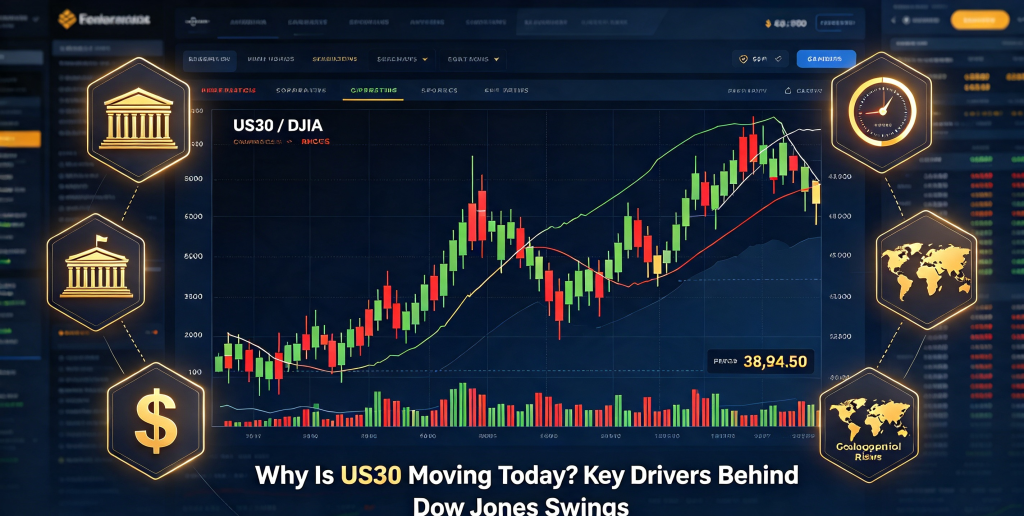
If you check the markets any given day, you will see the Dow Jones — known in trading circles as US30 — rising or falling, sometimes sharply, sometimes quietly. But what actually moves the index on a daily basis? It is rarely one single event; instead, the US30 responds to a layered mix of earnings news, economic data, monetary policy shifts, and sector-specific developments that together shift sentiment. Understanding these drivers is the difference between guessing the direction and actually recognising the forces at work.
Replace with your AdSense code in functions.php or via filter
1. Federal Reserve Policy & Interest Rate Expectations
More than any other factor, the US30 reacts to what the Federal Reserve does — and what markets expect it will do next. Because the index includes heavy financials, industrials, and interest-rate-sensitive companies, shifts in borrowing costs directly impact business conditions. When the Fed signals potential rate cuts, US30 typically rallies; when it hints at holding rates higher for longer, the index often pulls back. Every speech by Fed officials, every inflation report, and every jobs release is scrutinised for clues about the central bank’s next move.
2. Quarterly Earnings from Key Constituents
The US30 is price-weighted, meaning higher-priced stocks influence the index more heavily regardless of the company’s actual market value. This makes individual earnings reports disproportionately important: when Goldman Sachs, Microsoft, Apple, or UnitedHealth report results that beat or miss expectations, their share-price move can pull the entire index visibly. Because the index has only 30 components, one standout earnings surprise — or one major disappointment — can define the day’s direction.
3. Employment, Inflation & Economic Health Data
The Dow is viewed as a barometer of the broader American economy, so monthly data releases — Non-Farm Payrolls (NFP), Consumer Price Index (CPI), Producer Price Index (PPI), and GDP estimates — trigger immediate reactions. Strong jobs growth might initially lift sentiment but can also raise fears of sustained inflation and delayed rate cuts, creating a “good news is bad news” dynamic that confuses new traders. The index moves not on the headline number alone, but on how it compares to what economists and markets had already priced in.
4. Sector Rotation & Market Leadership Shifts
In 2026, the US30 has shown periods of strength relative to the tech-heavy NASDAQ — and periods of lagging behind it. This happens when investors rotate away from growth stocks toward more cyclical, value-oriented, and dividend-paying companies that dominate the Dow: industrials, financials, healthcare, and consumer staples. When money flows into “real economy” businesses, the US30 outperforms; when it rushes toward AI and mega-cap tech, the NASDAQ takes the lead.
5. Geopolitical Events & Global Stability
Trade tensions, conflicts, diplomatic breakthroughs, or energy price shocks all ripple through the index. Because many Dow components operate globally, instability overseas can hit revenue and supply chains. Conversely, de-escalation often produces relief rallies. The US30 tends to behave as a confidence gauge — when global uncertainty rises, investors may stick with established blue-chips, though in extreme “dash-for-cash” scenarios, all assets can be sold together.
6. US Dollar Strength & Bond Yield Movement
Rising Treasury yields make bonds relatively more attractive compared to equities, pressuring the index. A strengthening US dollar can weigh on multinational Dow companies that earn significant portions of revenue abroad — their foreign earnings translate back into fewer dollars. The reverse also holds: falling yields and a softer dollar often create a supportive backdrop for advances.
7. Pre-Market & Futures Cues
Regular stock market hours are 09:30–16:00 Eastern Time, but US30 futures trade nearly around the clock. Overnight moves in the S&P 500 and NASDAQ futures, news from Asia and Europe, and earnings reports released after hours all shape the opening price. Traders watch the pre-market action closely because the opening range often sets the tone for the entire session.
What This Means for You
The US30 is not moved by magic — it is moved by the collective reaction of market participants to changing conditions. No single driver works in isolation; earnings matter most when the economy is steady, Fed policy matters most when inflation is shifting, and geopolitics dominates when uncertainty spikes. The most reliable approach is to identify which driver is currently in the “driver’s seat” and align your analysis accordingly.
Disclaimer: This article is for informational purposes only and does not constitute financial advice. Always conduct your own research before trading.

Leave a Reply